

Making Climate Adaptation Finance Work for All in Tanzania
By Silvia Baur-Yazbeck, Financial Sector Specialist – CGAP, Mariadorin Shayo, Financial Inclusion Consultant, and Derick Kiwia, Climate Finance & Resilience Manager – FSDT
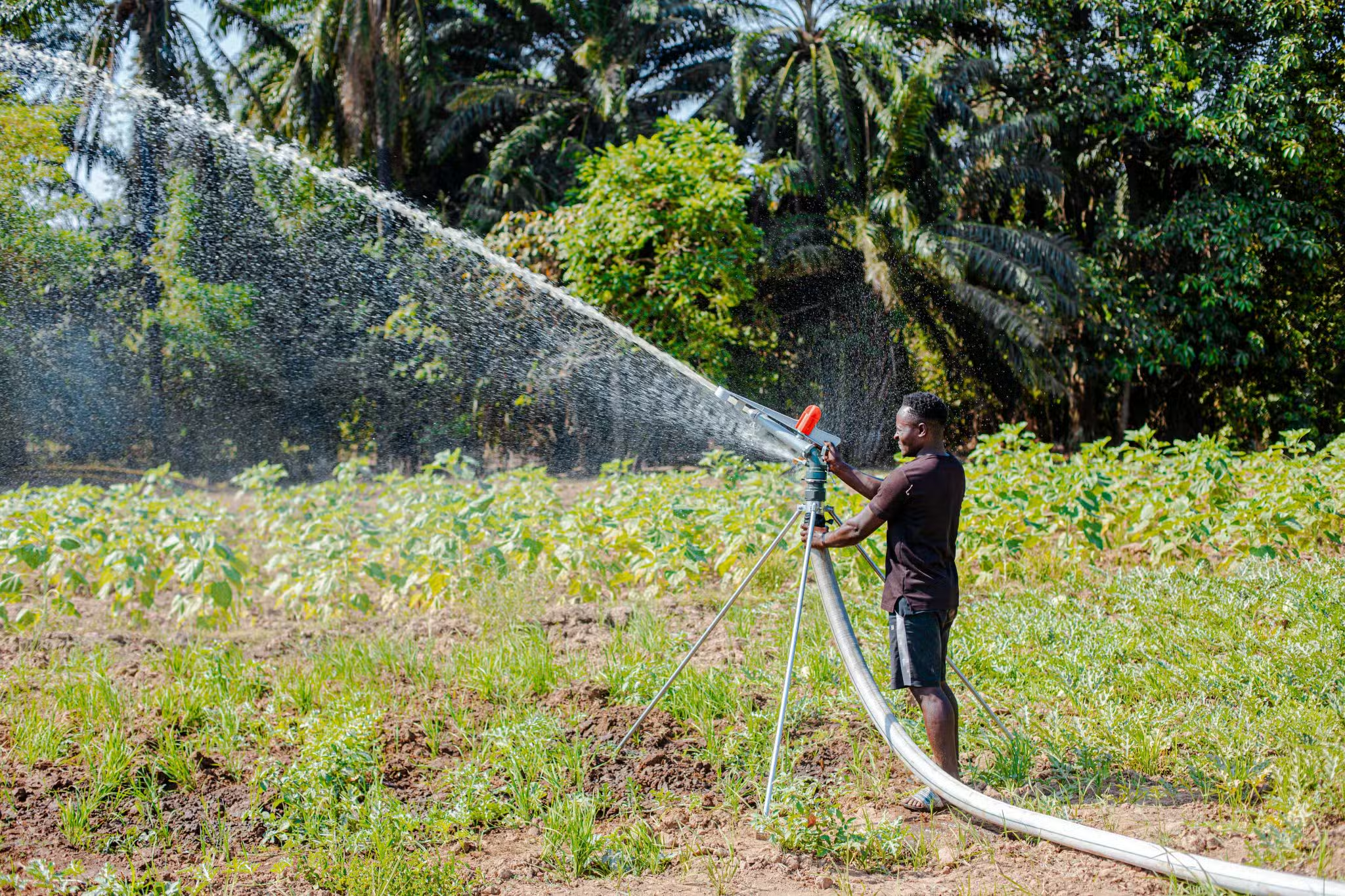
It is a story of extremes: when it rains, it pours – and when it doesn’t, it withers. Between late 2023 and mid-2024, Tanzania experienced devastating floods and landslides across several regions, leading to at least 155 fatalities, more than 200,000 affected, and tens of thousands displaced. In the same period, other parts of the country were parched by droughts, with the northern and central regions losing hundreds of thousands of livestock to water and pasture scarcity. According to UNDP’s 2023 Insurance and Risk Finance report, it is estimated that Tanzania incurs an annual average economic loss of $140 million due to drought-related yield losses of its main crops under current climate conditions.
In response to these shocks, and in anticipation of future ones, the Government of Tanzania and development partners are rolling out emergency relief and long-term resilience strategies. However, with rising public debt and declining donor financing amid global geopolitical shifts, financial service providers (FSPs) have a more urgent role to play and a growing business opportunity. By offering climate-responsive insurance, savings, credit, and payment solutions, they can help communities prepare for and recover from climate shocks, while creating additional revenue streams and strengthening the long-term resilience of the financial sector itself.
A few large banks are already staking their claim in Tanzania’s climate finance agenda, leveraging their financial and institutional capacity to invest in this fast-evolving field. Yet adaptation finance will only be inclusive if it flows through the institutions closest to climate-vulnerable communities. In Tanzania, that means ensuring that inclusive FSPs – those reaching lower income and vulnerable populations – are not left behind as climate capital mobilizes.
Inclusive FSPs Face Bigger Barriers
While Tanzania’s progress in mobilizing climate finance is commendable, a significant gap remains; inclusive FSPs, such as microfinance institutions (MFIs) and Savings and Credit Cooperative Organizations (SACCOs), often lack the capital, relationships, and know-how to initiate meaningful climate investments.
Banks and inclusive FSPs play complementary roles in Tanzania’s financial system. While banks are well-positioned to finance capital-intensive climate investments, inclusive FSPs are closer to small and medium-sized enterprises. Strengthening access to affordable capital for inclusive FSPs is key to enabling climate-responsive investments at the community and household levels.
National and international climate funding tends to favor large banks: accreditation and disbursement of funds require lots of upfront investment by the FSP to meet robust financial management, environmental and social safeguards, and to build in-house climate expertise. Larger banks are often better positioned to meet these requirements, while smaller FSPs struggle to compete for climate-related concessional funds. As a result, affordable climate adaptation financing largely remains inaccessible to FSPs serving climate-vulnerable customers, such as rural populations, farmers, fishers, and households living in the most climate-affected regions.
This is not merely a moral concern. Low-income and climate-vulnerable communities account for a large share of the agriculture sector, a backbone of Tanzania’s economy. When stability in these communities falters, agricultural production suffers, GDP growth slows, public finances are strained, and microeconomic risks multiply.
Four Changes to Unlock Climate Finance for Smaller FSPs
To address the challenges facing smaller FSPs, CGAP conducted a climate-finance readiness diagnostic with FSD Tanzania in June 2025, which identified four changes that are urgently needed:
- Re-design financing to allow for inclusive on-lending: National and international financing that offers concessional capital for on-lending needs to adjust to the capacity and needs of smaller and more inclusive FSPs. This means smaller ticket sizes, tiered pricing, aggregation or on-lending structures, and embedded technical assistance. Only then can smaller FSPs afford compliance, overcome operational barriers, and be incentivized to reach climate-vulnerable communities. Clear targets and performance-based subsidies can further encourage channeling investments through inclusive FSPs, rather than concentrating capital solely on large incumbents.
- Build climate finance capabilities of inclusive FSPs: Government, donors, and market facilitators need to create awareness about climate risk management approaches and climate-responsive product design to strengthen their customers’ and their own resilience, as well as regulatory compliance.
- Provide clear definitions and achievable standards for climate adaptation finance: the lack of a national green taxonomy constrains the recognition of investments and activities focused on adaptation and resilience. A more comprehensive set of definitions can enhance capital flows by boosting investor confidence about the impact of their funds, increasing transparency, and enabling improved climate finance monitoring. New definitions will need to be coupled with comprehensive training for FSPs on their application.
- Expand access to relevant climate risk data: The availability, quality, and use of climate risk data are still very limited in Tanzania. By making historical weather data, climate projections, geospatial asset data, and agricultural productivity and vulnerability projections easily available, innovators could develop products and services for FSPs to improve their risk assessments, lending activities, and product development.
The Government of Tanzania and its development partners have a catalytic role to play in boosting the resilience of climate-vulnerable communities by strengthening the flow of affordable finance to inclusive FSPs. Adaptation finance will only be inclusive if it flows through the institutions closest to climate-vulnerable communities. Strengthening these inclusive FSPs is not peripheral to Tanzania’s climate agenda; it is central to ensuring that adaptation finance reaches households, farmers, and small enterprises on the front lines of climate risks.
And the time for change is now. Without further action, Tanzania’s climate story could remain one of extremes: those with financial access gain the tools to prepare for and recover from climate shocks, while the most vulnerable, already underserved by the financial system, remain exposed and fall further behind.
This article was first published by CGAP at cgap.org/blog.