

From Invisible to Investable: How Data-first Design is Rewriting Rural Access to Credit in Kilombero
By Derick Kazimoto, Co-Founder – Black Swan and Happy Solo, Lead-Digital Financial Services & Infrastructure Development – FSDT
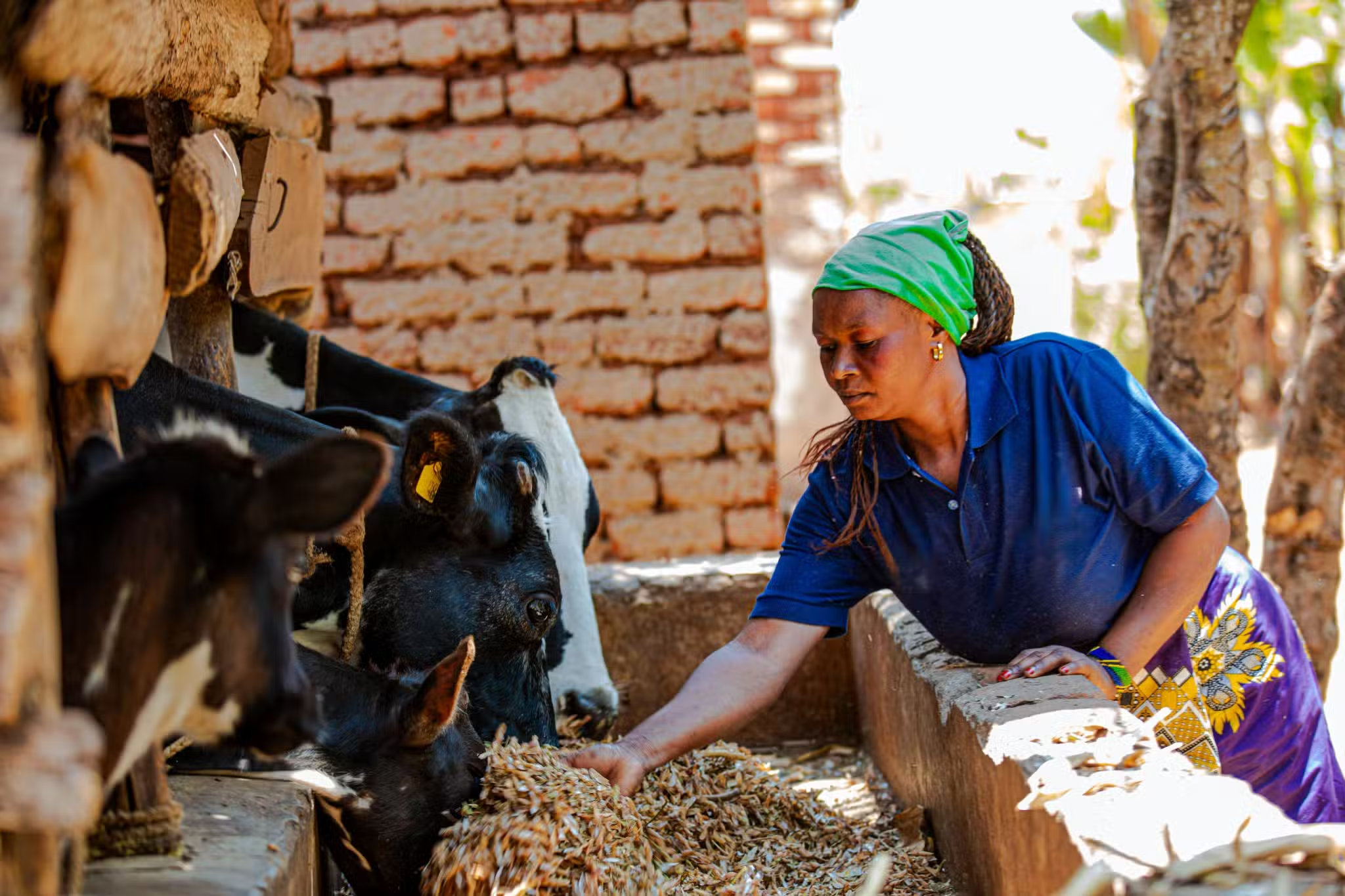
She knows exactly how much capital she needs this season. She has worked with banks before. She understands interest rates, repayment cycles, and risk. Yet one delayed decision means another planting season is lost.
Across the village, a young woman is a sugarcane farmer and runs a livestock business from her home. Money moves daily through her mobile wallet from several income-generating activities. Small amounts. Frequent transactions. No formal books. Her business is real, disciplined, and growing, but invisible to lenders.
Nearby, a woman manages the farm, negotiates buyers, and ensures obligations are met on time. On paper, however, none of it belongs to her. The phone, the account, and the financial records are registered under her husband’s name. Her contribution exists everywhere except in the systems that decide credit.
And then there is a customer who still travels to the branch every time. Not because they distrust banks, but because digital and remote onboarding is not yet fully accessible or well understood. To access cash, retrieve statements, or even understand their own spending, a physical visit is often the only option, especially when statements are needed for a credit application. Although their full financial history already exists within bank systems, including balances, transactions, and years of activity, the cost of accessing it is high. Travel expenses, time away from work, and long queues quietly push customers back toward cash-based behavior, reinforcing the very informality the financial system is trying to reduce. These are not edge cases. They are the everyday reality of rural finance.
Seeing farmers as they are
Upon learning about these challenges facing smallholder sugarcane farmers in Kilombero, the Financial Sector Deepening Tanzania (FSDT) identified a potential solution. In their capacity as financial sector market facilitators, FSDT convened key partners, including Kilombero Sugar Company as an off-taker, Creditinfo Tanzania for expertise in alternative credit infrastructure, Warioba Ventures for expertise in digital financial solutions, and financial service providers to develop an alternative credit scorecard. The scorecard uses non-traditional data—such as farm records, produce sales through Agricultural Marketing Cooperative Societies (AMCOS) and off-takers, social networks, farm size, and credit bureau history—to build a more accurate picture of farmers’ creditworthiness and address information asymmetry challenges. By turning this data into a comprehensive scoring model, the initiative is expected to provide access to productive loans for farmers who were previously excluded from the formal financial system. To date, the scorecard is being piloted by financial service providers across 17 AMCOS, covering 12,000 farmers and women-owned or led businesses.
Leaving no one behind
Most recently, efforts were made to improve the scorecard so that it works for all smallholder farmers and supports the needs of women-owned or led enterprises. Creditinfo Tanzania partnered with Black Swan, experts in Statement Analysis, to collect data required for the refreshment of the scorecard to incorporate a gender lens that intentionally addresses key gender norms affecting women’s access to productive credit. At the centre of Black Swan’s contribution was Manka, a financial data analysis engine, used to turn fragmented financial activity into coherent, lender-ready insight.
From daily behavior to credit intelligence
Execution mattered as much as intent. The project created 25 local youth jobs, training young people from the community to conduct data collection responsibly. Training focused on informed consent, data dignity, and helping entrepreneurs understand how sharing their information could translate into access to finance. This transformed the data collection process, reaching 2,107 female-owned or led enterprises from an extractive exercise into a shared community mission.
Using Manka, farmer data was analyzed and synthesised into complete financial profiles built from more than 1,000 structured and alternative data points, combining:
- Mobile money transaction statements
- Bank account statements
- Business and farming activity data
- Geo-location and operational context
- Credit reference bureau (CRB) reports
Rather than assessing women-owned or led enterprises through static snapshots, the analysis revealed patterns. These included how income flows across seasons, how expenses shift, how entrepreneurs manage volatility, and how they recover after lean periods, particularly within women-led and women-owned enterprises, where household and business finances often intersect, and resilience strategies differ.
By working together, FSDT, Warioba Ventures, Creditinfo Tanzania, Black Swan, and financial institutions were able to understand the business cycles of women-owned or led enterprises and then translate real behavior into credit product design, disbursement timing, and collection mechanisms aligned with their daily realities. Credit stopped being generic. It became seasonal, contextual, and human
Why informal finance still wins trust
One insight emerged consistently across Kilombero. When formal systems feel distant, slow, or unclear, people turn to what they trust. Women and youth enterprises often rely on Community Microfinance Groups, social lending circles, and community-based credit arrangements. Not because these systems are more advanced, but because trust within them is immediate and personal. Decisions are fast. Context is understood. Accountability is social.
By contrast, the formal financial ecosystem has often taken data without returning value. Applicants from rural areas would share information, yet see no feedback, no timelines, and no visible outcomes. Over time, this erodes trust and reinforces reliance on informal mechanisms. This initiative was designed to close that gap.
By making women-owned or led enterprises visible in a way that institutions can understand, and by ensuring data leads to real financial pathways, the project aimed to unlock opportunities for formal financial systems to serve such segments. Not by replacing informal finance, but by learning from it through proximity, context, and respect for lived behavior. As a result, the project also showcased to financial service providers the business case in serving women and meeting their productive credit needs.
From inclusion to infrastructure
The Kilombero experience shows that rural credit does not fail at the point of lending. It fails at the point of understanding. When financial systems are designed from the entrepreneur outward, thin-file customers become assessable. Risk becomes contextual. Credit decisions become faster, fairer, and more grounded. When visibility replaces assumption, credit stops being a barrier. It becomes an infrastructure.
Such initiatives are shaping the next phase of how credit intelligence is built and deployed across Africa. Insights from these entrepreneur-first implementations directly inform how platforms like Manka evolve, how data partnerships are structured, and how financial institutions can move faster from understanding to action.
As lenders and ecosystem partners look to design credit systems that truly work for rural and informal economies, the invitation is clear: build with context, test in real environments, and scale what proves its value on the ground. Such diverse complexities cannot be resolved by one player alone. Strategic partnerships, collaborations, and coordinated efforts among private and public sector players are critical.
Therefore, we call upon financial service providers, development partners, policymakers, and value chain players to join us in implementing these tailored and data-driven financial solutions. Together, we can strengthen resilience and improve the financial health of women micro, small, and medium enterprises in Tanzania.